Network Troubleshooting for Beginners: Fix Your Internet Step-by-Step
1. Physical Layer Checks (The Basics)
-
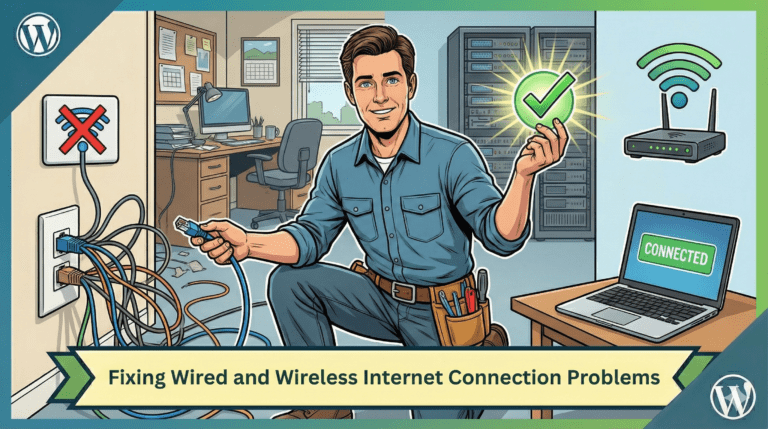
Check Connections: Ensure all Ethernet cables are securely plugged in. Cables can easily get kicked loose, cut by vacuum cleaners, or broken internally from being run over.
-
Verify Link Lights: Look at the Network Interface Card (NIC) or the switch port. If there are no lights, there is no connection.
-
Fix: Unplug and reseat the cable until you hear a click. If lights still don’t turn on, try a known good cable.
-
-
Wireless Checks: Ensure you are connected to the correct Wi-Fi access point (SSID). Connecting to the wrong network (e.g., a guest network instead of corporate) can prevent access to internal resources like file shares.
2. Verifying the Adapter Status
-
Windows:
-
Go to Control Panel > Network and Sharing Center > Change adapter settings.
-
Check if the adapter is “Disabled” (grayed out). Right-click and select Enable if necessary.
-
Command Line: Run
netsh interface show interfaceto see the “Admin State” of adapters. You can usenetsh interface set interface "Ethernet0" admin=enable(requires Administrator privileges) to enable it.
-
-
Linux:
-
Use
ip -br -c addr(brief, color) to see the state of interfaces (UP vs. DOWN). -
Alternatively, use
ifconfigto check for transmit/receive packets. If a network is down, you will see zero packets and bytes transferring.
-
3. Connectivity Tests (Ping & Trace Route)
-
Internal Ping: Ping your gateway (router), typically something like
192.168.1.1. If this replies, your internal network is working. -
External Ping: Ping a known internet address like
1.1.1.1(Cloudflare). If you get replies, your internet connection is active. -
Trace Route:
-
Tool:
traceroute(Linux) ortracert(Windows). -
Purpose: Shows every “hop” (router) your data takes to reach its destination. If it stops responding at a specific hop, that is likely where the connection is breaking.
-
4. IP Addressing Issues (DHCP & APIPA)
-
APIPA Warning: If your IP address starts with
169.254.x.x, this is an APIPA address. It means your computer failed to reach the DHCP server to get a real IP, so it assigned itself a temporary one. You will not have internet access. -
The Fix (Release/Renew):
-
Linux:
sudo dhclient -r [interface]to release, thensudo dhclient -v [interface]to renew. -
Windows:
ipconfig /releasefollowed byipconfig /renew. If you still get a 169.254 address, the issue is likely with the DHCP server (router).
-
-
Subnet Mask Check: Ensure your subnet mask matches the network (e.g.,
255.255.255.0). A wrong static mask can prevent communication.
5. DNS Troubleshooting
-
The Symptom: You can ping an IP address (e.g.,
1.1.1.1) but cannot ping a domain name (e.g.,google.com). This means DNS is broken. -
The Fix:
-
Check Settings: Ensure your DNS server is correct in adapter properties or via
ipconfig /all. -
Flush Cache (Windows): Run
ipconfig /flushdnsto clear out old/bad DNS records . -
Flush Cache (Linux): Commands vary, but
sudo resolvectl flush-cachesis common on systemd-based systems.
-
6. The “Nuclear Option” (Resetting the Stack)
-
Windows Winsock Reset: If all else fails, run
netsh winsock reset. This completely rebuilds the TCP/IP stack in Windows and often fixes stubborn, unexplainable issues. A reboot is required afterwards. -
Linux Network Manager: Restart the networking service using
sudo systemctl restart NetworkManager.