AI, Blockchain, and Quantum Computing: How Three Technologies Are Reshaping the World
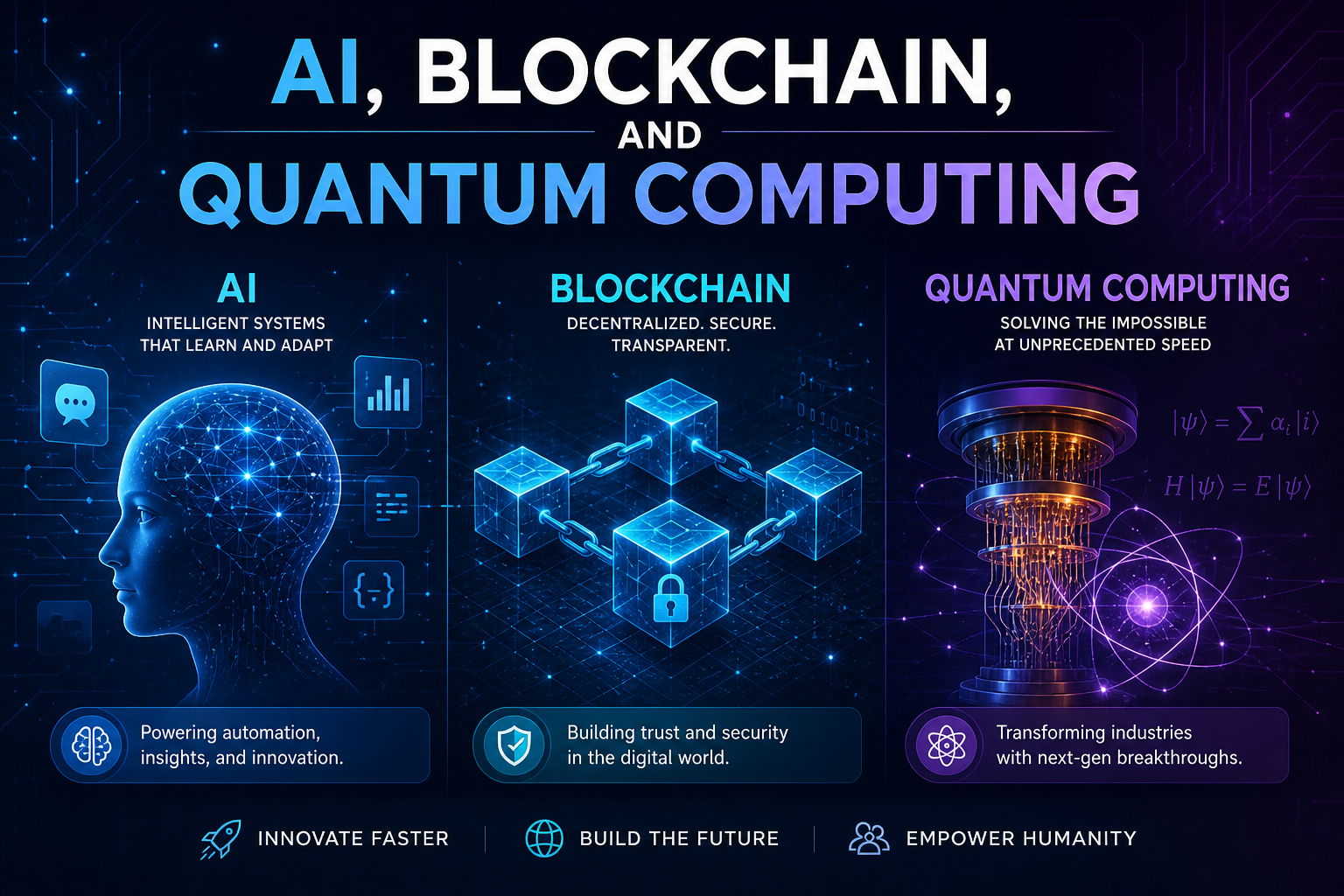
Three technologies are generating more serious attention from governments, enterprises, and researchers than any others in 2026 — artificial intelligence, blockchain, and quantum computing. Each is transformative on its own. Understanding how they interact, where they genuinely complement each other, and where the boundaries between hype and real-world deployment lie is more useful than treating them as separate topics with separate bullet-point summaries.
This article goes deeper than definitions. It covers what each technology is actually doing in production environments right now, the specific ways they create compounding value when used together, the sectors where that combination is most consequential, and the genuine challenges — technical, regulatory, and economic — that determine how quickly their impact scales. India-specific context is woven throughout, because the implications of all three technologies for the Indian economy, government, and workforce are substantial and specific.
Artificial Intelligence in 2026: Beyond the Chatbot Phase
The public narrative around artificial intelligence has been dominated by large language models and generative AI since 2022. That framing, while not wrong, misses the more consequential shift happening in parallel: the deployment of AI into high-stakes decision-making processes across healthcare, finance, manufacturing, and infrastructure at a scale and reliability level that was not achievable two years ago.
The underlying reason is model capability improvement compounding with deployment infrastructure maturity. AI systems in 2026 are not just answering questions — they are operating as components of production systems making consequential decisions. FDA-cleared AI systems are reading radiology images in clinical workflows at hundreds of hospitals. AI trading systems execute the majority of equity market volume on major exchanges. AI underwriting models assess credit risk for billions of dollars of lending decisions daily. The question for AI in 2026 is not whether it works — in specific, well-defined domains it clearly does — but how to deploy it responsibly, how to audit its decisions, and how to handle the cases where it fails.
The governance dimension is as important as the technical one. The EU AI Act, which entered enforcement in 2026, is the world’s first comprehensive AI regulatory framework. It creates risk tiers for AI applications — unacceptable risk (banned), high risk (strict requirements for transparency, human oversight, and accuracy), limited risk, and minimal risk. High-risk categories include AI in healthcare diagnostics, credit scoring, recruitment, law enforcement, and critical infrastructure. Companies deploying AI in these domains in EU markets face registration, documentation, and audit requirements that do not yet have equivalents in most other jurisdictions, but which are shaping the global conversation about AI governance.
India’s approach is developing through the Ministry of Electronics and Information Technology’s AI governance framework and IndiaAI Mission, launched in 2024 with ₹10,372 crore (approximately $1.25 billion) in government funding. The mission covers compute infrastructure (building a 10,000+ GPU national AI compute facility), foundational model development, datasets, application development in priority sectors, and startup support. The strategic intent is to build Indian AI capability rather than being purely a consumer of AI systems developed elsewhere — a recognition that AI capability increasingly correlates with economic and national security power.
The most practically consequential AI development for India’s economy may be AI’s impact on the IT services and BPO sectors, which employ millions of people and generate significant export revenue. AI systems that can perform coding assistance, data analysis, document processing, and customer service at scale compress the labour cost advantage that has historically driven India’s competitiveness in these markets. The response — moving up the value chain to higher-complexity services, AI integration consulting, and AI system development — is the strategic direction, but the transition involves real workforce adjustment challenges that training and education policy needs to address proactively.
Blockchain in 2026: Where It Delivers Real Value and Where It Doesn’t
Blockchain has had a complicated public narrative — overhyped in the cryptocurrency boom of 2021, discredited in the crash of 2022, and now settling into a more measured deployment pattern where the technology’s genuine strengths are being applied to problems it is actually well-suited to solve.
The core value proposition of blockchain is specific and worth stating precisely: it creates a shared record of transactions or states that multiple parties with divergent interests can trust without requiring a central authority to maintain it. This is valuable in exactly the situations where that specific problem exists — where multiple organisations need to share data, where no single organisation is trusted by all others to maintain the authoritative record, and where the cost of creating and operating a trusted central authority is higher than the cost of running a distributed ledger.
That problem description fits fewer business situations than the 2017–2021 hype cycle implied, but it fits some important ones genuinely well.
Supply chain provenance is the clearest production-scale success story. Walmart’s Food Safety Collaboration, built on IBM’s Food Trust blockchain platform, traces produce from farm to store shelf and has reduced the time to trace the origin of a food safety incident from days to seconds — a capability with direct implications for outbreak containment. The Maersk TradeLens platform (which faced commercial challenges separate from the technology’s effectiveness) and similar projects have demonstrated blockchain’s ability to create a shared, trusted record of cargo movement across shipping lines, port authorities, customs agencies, and freight forwarders who have historically operated on incompatible systems.
Cross-border payments and remittances are another domain where blockchain’s value proposition is clear. Traditional correspondent banking for international transfers involves multiple intermediary banks, each charging fees and adding settlement time. Blockchain-based payment networks — Ripple’s XRP Ledger, Stellar, and central bank digital currency (CBDC) systems built on distributed ledger foundations — can settle international transfers in seconds at a fraction of the traditional cost. For India, which received approximately $120 billion in remittances in 2023–24 (the world’s largest recipient), even modest reductions in transfer costs represent billions of dollars in value to receiving families.
India’s own blockchain initiatives are significant. The Reserve Bank of India’s digital rupee (e₹) pilot, launched in 2022 and expanded through 2025–26, is one of the world’s most advanced CBDC programmes by transaction volume. The e₹ uses a centralised ledger (technically distinct from a public blockchain) but demonstrates the government’s commitment to digital currency infrastructure. The National Blockchain Framework, developed by the Ministry of Electronics and Information Technology, provides a standardised architecture for government blockchain applications in land records, certificate verification, and supply chain management.
The honest assessment of enterprise blockchain is that many early projects failed because they applied blockchain to problems that did not actually require distributed trust — they were situations where a well-designed central database with strong access controls would have been simpler, cheaper, and equally effective. The projects that survived and scaled are those where the distributed trust property is genuinely essential to the use case. Understanding this distinction is what separates productive blockchain adoption from expensive experiments.
Quantum Computing in 2026: The Real State of a Misunderstood Technology
Quantum computing is the technology most frequently misrepresented in popular technology coverage, in both directions — simultaneously overhyped as being years away from transforming everything and underhyped by those who dismiss it as perpetually five years away from practicality.
The accurate picture requires understanding a distinction that most coverage omits: the difference between quantum advantage for specific narrow problems (which already exists in limited demonstrations) and fault-tolerant quantum computing (which would make quantum computing broadly applicable across complex real-world problems, and which does not yet exist at commercial scale).
Current quantum computers — IBM’s 1,000+ qubit Condor and Heron systems, Google’s Willow chip, IonQ’s trapped-ion systems, and a range of competitors — are what researchers classify as Noisy Intermediate-Scale Quantum (NISQ) devices. The “noisy” designation is the critical qualifier: gate error rates in current systems mean that longer quantum circuits accumulate errors that overwhelm the computation before it completes. The algorithms that would provide exponential speedups for drug discovery, financial optimisation, and cryptographic breaking all require error-corrected quantum circuits far longer than current hardware can reliably execute.
Google’s December 2024 Willow chip announcement deserves specific mention because it was widely reported as a breakthrough. Willow demonstrated that error rates decrease as the number of physical qubits per logical qubit increases — confirming a key theoretical prediction about error correction scaling. This is a genuine and important experimental result. What it demonstrated is not that fault-tolerant quantum computing is imminent, but that the physics of error correction works as theorists predicted, which is significant scientific validation. The practical implication is progress on the roadmap toward fault tolerance, not arrival at fault tolerance.
IBM’s publicly stated roadmap targets a 100,000-qubit fault-tolerant system in the early 2030s. Microsoft is pursuing topological qubits — a fundamentally different physical implementation that Microsoft claims will produce inherently lower error rates — with a significant experimental validation announced in 2025. PsiQuantum is building photonic quantum computers specifically designed for eventual silicon chip fabrication manufacturing at scale. These represent genuinely different technical bets on which physical approach to fault-tolerant quantum computing will succeed first.
The near-term applications that can provide value with current NISQ-era hardware are narrower than commonly presented. Quantum simulation of small molecular systems for specific chemistry and materials science problems is showing genuine advantage in research settings. Quantum optimisation heuristics for specific industrial problems — portfolio optimisation with certain constraint structures, specific logistics routing problems — are being explored in production pilots by financial institutions and logistics companies. These are real applications; they are not the broad commercial transformation the 2021 hype cycle described.
The one area requiring near-term action regardless of when fault-tolerant quantum computers arrive is cryptography. The NIST post-quantum cryptography standards finalised in August 2024 (ML-KEM, ML-DSA, SLH-DSA) provide the migration path away from RSA and elliptic curve cryptography toward algorithms resistant to quantum attacks. Organisations handling data with long-term sensitivity requirements — financial records, healthcare data, government communications, intellectual property — should be inventorying cryptographic dependencies and planning migration now, because “harvest now, decrypt later” attacks by well-resourced state actors represent a present risk even before fault-tolerant quantum computers exist.
How These Three Technologies Create Compounding Value Together
The most interesting analysis is not of each technology in isolation but of how they interact — where the combination produces capabilities that none could achieve independently.
AI and Blockchain: Trustworthy Intelligence
The fundamental tension in deploying AI in high-stakes domains is accountability: when an AI system makes a consequential decision, who is responsible, and how can that decision be audited? AI models are often described as “black boxes” — their internal reasoning is not directly interpretable, and the data they were trained on can encode biases that produce systematically unfair outcomes.
Blockchain provides an immutable audit trail for AI decision-making at a granularity that traditional logging systems cannot match. Every input to the model, the model version used, the output produced, and the action taken can be recorded in a tamper-proof ledger that multiple parties can verify independently. For AI systems making decisions in regulated domains — credit scoring, medical diagnosis, insurance underwriting — this creates an auditable record that satisfies regulatory requirements for explainability and accountability.
The combination also addresses data provenance for AI training. Training data quality is a primary determinant of AI model quality, and the provenance of training data — where it came from, whether it was collected with appropriate consent, whether it has been manipulated — is increasingly scrutinised by regulators. Blockchain-based data provenance systems can create verifiable records of data origin and handling that are difficult to forge and easy to audit.
In practice, Ocean Protocol and Gaia-X (a European data infrastructure initiative) are building blockchain-based data marketplaces where organisations can share data for AI training while maintaining provenance records and access control. The Indian Data Accessibility and Use Policy and the Digital Personal Data Protection Act 2023 create a regulatory environment where data provenance tools that blockchain can provide have direct compliance value.
Quantum Computing and AI: Accelerating the Unsolvable
AI training at the frontier — the large language models and multimodal systems that define current AI capability — requires enormous computational resources. Training GPT-4 scale models reportedly cost over $100 million in compute. This cost creates a concentration effect: only organisations with vast resources can train at the frontier, while most organisations consume capability through APIs rather than developing it.
Quantum computing’s potential impact on AI is not in making existing AI algorithms run faster on the same hardware — it is in enabling new classes of optimisation and sampling algorithms that classical computers cannot efficiently execute. Quantum machine learning algorithms, if they can be reliably implemented on fault-tolerant hardware, could train certain model architectures on certain problem types with exponentially fewer compute resources. This is a theoretical capability that current NISQ hardware cannot yet demonstrate at commercially meaningful scale — but the theoretical foundations are well-established.
The more immediate interaction is in simulation: AI-guided quantum chemistry simulations that use classical AI to navigate the quantum simulation search space more efficiently than pure quantum algorithms alone. Microsoft and IBM both have research programmes combining classical ML with quantum simulation for drug discovery and materials science applications. This hybrid classical-quantum approach is the most practical near-term expression of quantum-AI synergy.
Blockchain and Quantum Computing: Threat and Response
The interaction between blockchain and quantum computing is primarily a security story — and specifically a risk story. Most blockchain networks, including Bitcoin and Ethereum, use elliptic curve cryptography for digital signatures. A fault-tolerant quantum computer running Shor’s algorithm could break elliptic curve cryptography, potentially compromising the security of blockchain transactions and wallets.
This is a known risk that the blockchain community is actively addressing. Ethereum’s roadmap includes migration to quantum-resistant signature schemes. The Bitcoin developer community is debating the approach and timeline for similar migration. NIST’s post-quantum cryptography standards provide the technical basis for this migration. The transition is complex because it requires coordination across decentralised networks where no central authority can mandate an upgrade, but the cryptographic path forward is clear.
The positive interaction is that quantum computing, when it matures sufficiently, can enhance blockchain cryptography as well as threaten it. Quantum key distribution (QKD) — using quantum mechanical properties to distribute cryptographic keys with theoretically unbreakable security — can provide the key exchange layer for blockchain networks that is provably secure against quantum attacks. China has the most advanced QKD deployment globally, with a 2,000-kilometre quantum communication backbone connecting Beijing and Shanghai. India’s Department of Science and Technology has QKD research programmes, and commercial deployment in sensitive government and financial communications is a realistic near-term application.
Where the Combination Is Being Deployed: Four Real Sectors
Healthcare: Speed, Privacy, and Precision
Healthcare is the sector where the convergence of all three technologies has the most direct human impact. AI diagnostic systems — Viz.ai for stroke detection from CT scans, PathAI for pathology slide analysis, Tempus for genomic oncology — are in clinical deployment at scale. The AI performance in these narrow, well-defined tasks has in specific studies been competitive with specialist physicians, though broader deployment raises questions about generalisation, bias, and liability that are being worked through in regulatory frameworks.
Blockchain’s role in healthcare data is privacy-preserving data sharing. Clinical AI model training requires large datasets — ideally from multiple hospitals across diverse patient populations. Hospitals are reluctant to share patient data with competitors or third parties due to privacy regulations (HIPAA in the US, the Digital Personal Data Protection Act in India). Federated learning combined with blockchain can allow AI models to be trained across distributed datasets without the underlying patient data ever leaving the originating institution — the model parameters, not the data, are shared, and the blockchain records what data contributed to which model version.
Quantum computing’s healthcare application is primarily in drug discovery — using quantum simulation to model protein folding and molecular interactions at a level of accuracy that classical computers cannot achieve for larger molecules. Roche, Pfizer, and Biogen have active quantum computing research partnerships with IBM and other providers specifically for this application. The practical near-term output is better computational tools for chemists rather than quantum computers autonomously discovering drugs — but the trajectory toward more autonomous quantum-assisted discovery is clear.
Finance: Efficiency, Security, and New Infrastructure
Financial services have the highest density of all three technology deployments of any sector. AI is embedded throughout: algorithmic trading (AI-driven strategies execute the majority of exchange volume), fraud detection (real-time transaction monitoring using ML models), credit underwriting (alternative data and ML models for lending decisions), and regulatory compliance (NLP-based monitoring of communications and transactions for compliance violations). JPMorgan Chase’s COiN programme, which uses AI to review legal documents, and Goldman Sachs’s AI-assisted coding tools that the firm says have meaningfully improved developer productivity are both production deployments at significant scale.
Blockchain in finance has moved past the cryptocurrency association that dominated early coverage. SWIFT’s blockchain-based cross-border payment trials, JPMorgan’s Onyx platform for wholesale payment settlement, and the RBI’s e₹ digital rupee represent different points on the spectrum from private enterprise to central bank adoption. The Bank for International Settlements’ Project mBridge — a multi-CBDC platform involving the central banks of China, Hong Kong, Thailand, UAE, and the BIS — is exploring how CBDCs can settle cross-border payments with finality in seconds rather than days.
Quantum computing in finance is in the experimental phase, with financial institutions including Goldman Sachs, JPMorgan, and HSBC running quantum computing research programmes focused on portfolio optimisation, options pricing, and risk simulation. The near-term output is research insights and readiness rather than production deployment — and the cryptographic migration to post-quantum standards is a more immediate practical obligation than quantum computing adoption.
Government and Public Services: India’s Particular Opportunity
India’s digital public infrastructure — Aadhaar (biometric identity for 1.4 billion people), UPI (Unified Payments Interface processing over 10 billion transactions monthly), DigiLocker (digital document storage), and the National Health Mission’s health ID system — represents one of the world’s most advanced government technology deployments at population scale. These systems are the foundation on which AI, blockchain, and quantum computing capabilities in the public sector will build.
AI applications in Indian government are expanding from the theoretical to the operational. AI-assisted crop advisory systems from the Ministry of Agriculture, AI-based income tax return processing (which the Income Tax Department has deployed to reduce processing time dramatically), and AI-driven traffic management in smart city deployments are all in production. The IndiaAI Mission’s focus on AI applications in agriculture, healthcare, and education in Indian languages — building models that work for India’s linguistic diversity rather than defaulting to English-language systems — addresses a fundamental limitation of current AI systems for Indian public service delivery.
Blockchain applications in Indian government services are most advanced in land record management. Andhra Pradesh, Telangana, and other states have piloted blockchain-based land registry systems that create tamper-proof records of property ownership — addressing a significant source of property disputes and fraud that burdens both citizens and courts. National Blockchain Framework deployments for educational certificate verification (preventing fake degree fraud), supply chain management for the public distribution system, and drug supply chain integrity are in various stages of pilot and deployment.
Manufacturing and Supply Chains: The Efficiency Stack
Manufacturing is where the combination of AI (process optimisation and quality control), IoT sensors (real-time data from equipment and products), digital twins (virtual models of physical processes), and blockchain (provenance and certification tracking) is creating what some analysts describe as the fourth industrial revolution’s full realisation.
Siemens, Bosch, and Mahindra have deployed AI-based quality inspection systems that use computer vision to detect defects at speeds and accuracy rates that manual inspection cannot match. Tata Steel’s AI optimisation of blast furnace operations has reportedly produced energy efficiency improvements in production. These are not demonstrations — they are production deployments with measurable economic impact.
The blockchain component addresses the certification and provenance dimension that is increasingly demanded by global supply chains: proof that a component was manufactured to specification, that raw materials were sourced ethically, that cold chain requirements were maintained for pharmaceuticals or food products. The EU’s Carbon Border Adjustment Mechanism (CBAM), which requires documentation of the carbon content of imported goods, is creating a specific demand for supply chain provenance systems that blockchain is well-positioned to address. Indian exporters to EU markets need to comply with CBAM from 2026, making this a near-term commercial necessity rather than a future aspiration.
The Honest Assessment: Where We Actually Are
The most useful thing a technology analysis can do is resist the temptation to make everything sound equally imminent. The honest assessment of where AI, blockchain, and quantum computing are in 2026 is:
AI is the most immediately consequential of the three, with production deployments across healthcare, finance, government, and enterprise that are already generating measurable economic impact. The challenges are governance, reliability, bias, and labour market disruption — not whether the technology works.
Blockchain has found its genuine use cases after a painful period of overapplication to problems it was not suited for. Cross-border payments, supply chain provenance, CBDCs, and public record integrity are real, deployed applications. The technology does not need to be applied to every data problem — only those where distributed trust is the core requirement.
Quantum computing is the technology furthest from broad commercial impact but closest to a specific critical transition — the move from NISQ-era demonstrations to fault-tolerant systems. That transition will, when it occurs, have significant implications for cryptography (requiring immediate response from all organisations) and for drug discovery and materials science (creating competitive advantage for early adopters). The post-quantum cryptography migration is the near-term quantum computing action item for most organisations, regardless of when fault-tolerant systems arrive.
Understanding these timelines accurately — not conflating AI’s current deployability with quantum computing’s future potential — is what distinguishes strategic positioning from technology hype consumption.
This article is written for informational and educational purposes. Technology landscapes and deployment scales change rapidly. For strategic, investment, or policy decisions involving these technologies, consult qualified professionals with domain expertise relevant to your specific context.