Gadget Reviews 2026: What’s Hot, What’s Not, and What’s Actually Worth Buying
The gadget market in 2026 has more genuinely good options at more price points than at any time before — and more mediocre products dressed in impressive marketing than ever before. Understanding which is which requires going beyond spec sheets and launch-event excitement to ask how a device performs in actual daily use, what its competitors offer at the same price, and whether the headline features translate into real-world value.
This review covers the gadget categories generating the most attention in 2026, with honest assessments of what is working, what is falling short of expectations, and which specific devices represent genuine value for Indian buyers. All prices are current Indian market pricing from Flipkart and Amazon India as of May 2026.
What’s Genuinely Hot: The Gadget Trends Delivering Real Value
AI-Native Smartphones: Qualcomm Snapdragon 8 Elite Changes the Game
The Qualcomm Snapdragon 8 Elite chipset, which powers the 2025–2026 generation of premium Android smartphones, contains a Hexagon NPU capable of 45 TOPS (trillion operations per second) of on-device AI inference. This is not a marketing number — it translates into real capabilities that prior generations could not deliver. Real-time call translation (translating a phone call from Hindi to English or vice versa in your ear, live), on-device generative photo editing that runs in seconds without cloud connectivity, and AI-powered low-light photography processing that rivals computational photography systems costing twice as much.
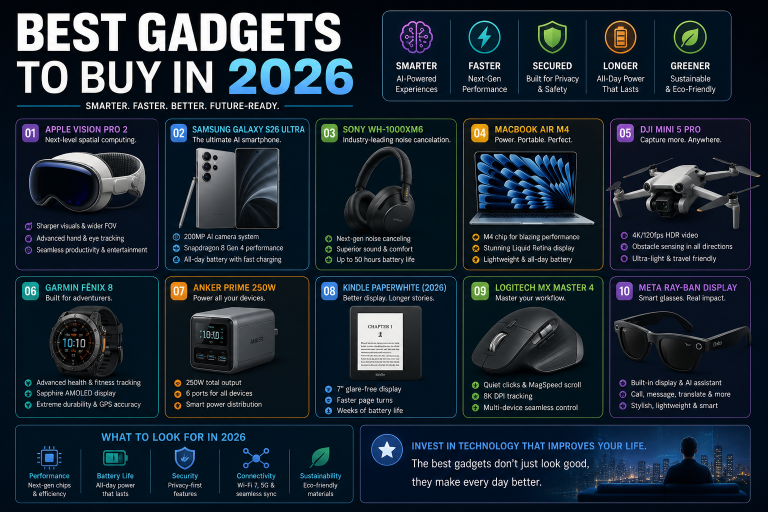
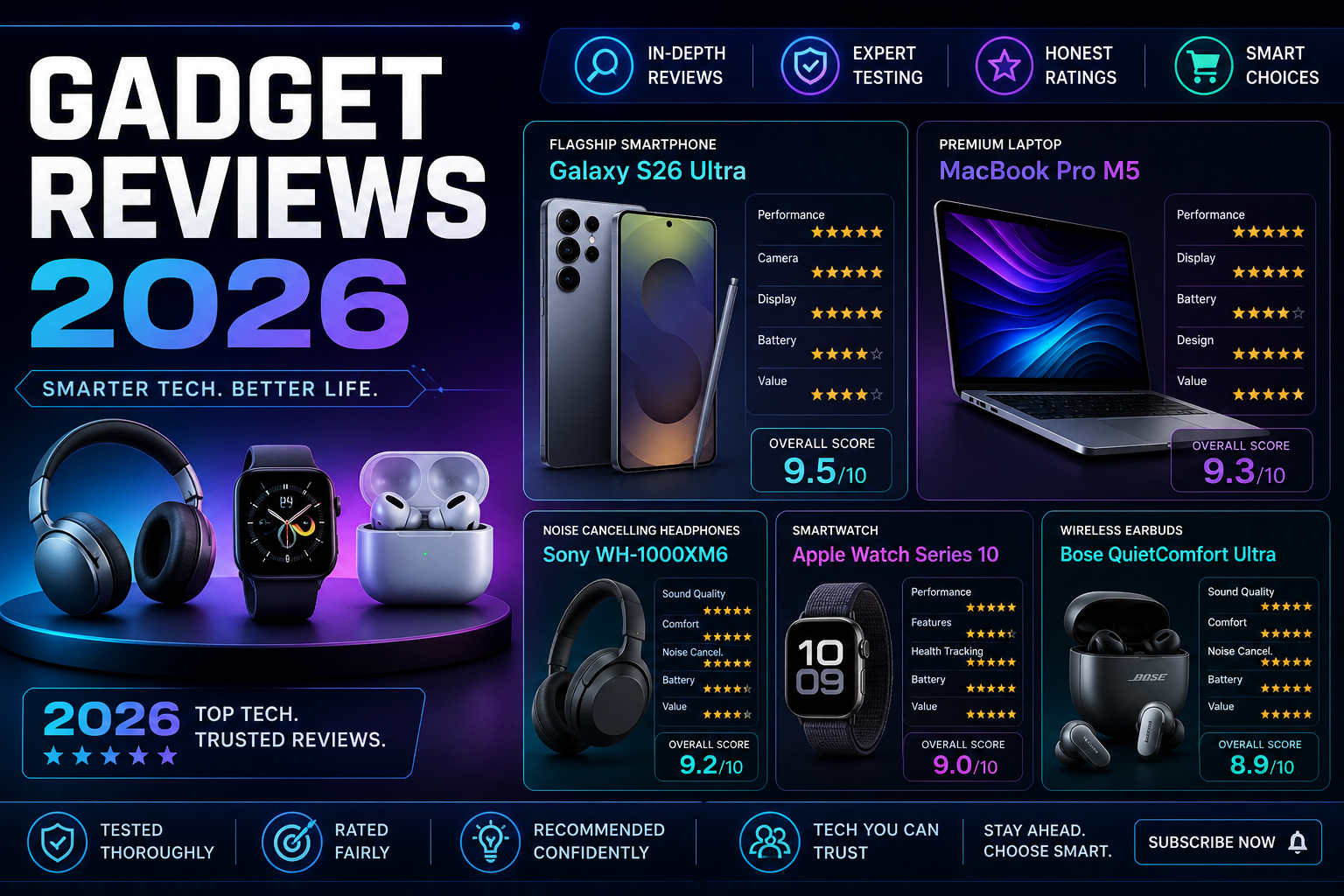
The Samsung Galaxy S25 Ultra (₹1,30,999 for 12GB/256GB) and the OnePlus 13 (₹69,999 for 12GB/256GB) are the clearest expressions of Snapdragon 8 Elite capability at different price points. The S25 Ultra’s Galaxy AI features — including Live Translate, Circle to Search, and Generative Edit — are genuinely useful rather than demo features that get used once. The OnePlus 13 delivers the same raw processing performance at roughly half the price, with less polished AI software but identically capable hardware.
The practical implication: if you are buying a premium smartphone in 2026, the AI processing capability of the chipset is now a meaningful differentiator rather than a checkbox — but only if the software layer from the manufacturer translates that hardware into useful features. Samsung and Apple do this better than most Android alternatives at this price tier.
Foldable Phones: The Samsung Galaxy Z Fold 6 Finally Makes the Case
Foldable phones have spent four generations being impressive proofs of concept that were difficult to recommend in practice. The Samsung Galaxy Z Fold 6 (₹1,64,999) is the first in the line that is genuinely recommendable without significant caveats — not because it is perfect, but because the remaining compromises are now ones that most users will not encounter daily.
The crease in the display is still visible under certain lighting conditions but is no longer something most users notice after the first day of use. The hinge mechanism is rated to 200,000 folds, and Samsung’s drop test improvements have produced a device that handles real-world handling without the anxiety of prior generations. The main display at 7.6 inches is genuinely productive — the split-screen multitasking that Android 15 enables on this display is the most compelling productivity use case the form factor has produced.
Where the Z Fold 6 still falls short: the camera system, while good, is behind the Galaxy S25 Ultra and iPhone 16 Pro at the same or lower prices. The 4,400mAh battery does not comfortably last a full day under heavy use — running two apps side by side on a large display is energy-intensive. And at ₹1,64,999, it needs to be genuinely transformative to justify its price over a ₹1,30,999 Galaxy S25 Ultra with a better camera, better battery life, and equivalent software.
Verdict: Worth buying if the large-screen multitasking use case genuinely matches your daily work. Not worth the premium over a conventional flagship if your usage is primarily single-app.
True Wireless Earbuds: The ₹3,000–₹8,000 Sweet Spot
The earbud market has matured to the point where the experience gap between a ₹3,000 mid-range earbud and a ₹25,000 premium one has narrowed significantly for the most common use cases. The Sony WF-C700N (₹6,490) is the clearest example of this convergence — it delivers active noise cancellation that independently-tested reviewers have measured at approximately 20dB of consistent noise attenuation, a comfortable lightweight design at 4.6g per earbud, and the Sony sound signature that has been refined across multiple generations.
The Sony WF-1000XM5 (₹19,990) still leads on absolute ANC performance and sound quality — its Integrated Processor V2 and Dual Noise Sensor technology deliver noticeably better performance in variable noise environments like aircraft cabins and loud offices. For most users in typical use environments, the performance gap versus the WF-C700N is real but smaller than the price difference suggests.
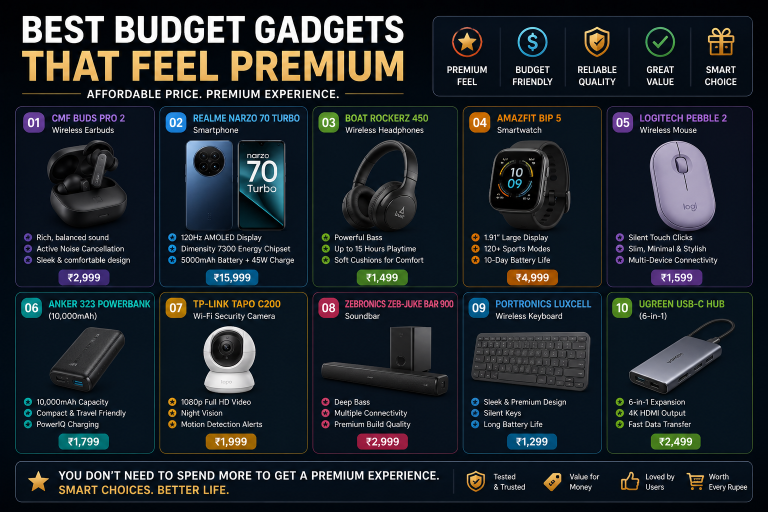
At the budget end, the OnePlus Nord Buds 3 Pro (₹3,499) has redefined what ₹3,000–₹4,000 earbuds can deliver — 49dB ANC attenuation (a figure that competes with earbuds costing three times as much in consistent noise environments), a 12.4mm dynamic driver that produces noticeably more bass extension than competing budget options, and dual connection that allows simultaneous pairing with two devices. For the majority of everyday earbud use cases, the Nord Buds 3 Pro is the honest answer to “what earbuds should I buy.”
Smart TVs: The QLED vs OLED Decision Has a Clear Answer Now
The premium television market in 2026 has made the QLED vs OLED decision clearer than it has ever been. Samsung’s QN90D Neo QLED (55-inch at approximately ₹1,10,000) and LG’s C4 OLED (55-inch at approximately ₹1,20,000) represent the current best of each technology.
OLED’s per-pixel illumination produces perfect blacks and infinite contrast ratio — in a dim or dark room, the visual quality difference over QLED is immediate and significant. The LG C4 also supports 144Hz refresh rate and HDMI 2.1 bandwidth for gaming, making it the better choice for users combining cinematic viewing with gaming.
Samsung’s Neo QLED counters with higher peak brightness (up to 4,000 nits versus OLED’s 1,000–1,500 nits peak), which makes a meaningful difference in bright room viewing and HDR highlights. It also avoids OLED’s primary remaining limitation — burn-in risk from static content displayed for extended periods, which is a real concern for users who watch news channels with static logos or use the TV as a monitor.
The honest answer: If your room gets significant ambient light during viewing, or if you plan to use the TV for extended gaming with static HUD elements, the Neo QLED is the better choice. If you watch primarily in a controlled lighting environment and prioritise image quality for films and streaming content, the LG C4 OLED is the superior display.
What’s Not Living Up to the Hype: Specific Disappointments in 2026
Generative AI Camera Features: Impressive Demos, Inconsistent Reality
Every major smartphone manufacturer launched 2026 flagships with generative AI camera features — the ability to remove objects from photos, extend backgrounds, and add elements that were not in the original frame. Samsung’s Generative Edit, Google’s Magic Eraser and Add Me, and Apple’s Clean Up tool are all versions of the same capability.
The honest assessment after months of real-world use: these features work impressively in controlled demonstrations and inconsistently in everyday photography. Object removal works well for simple subjects against uncomplicated backgrounds. It struggles with complex edges, moving subjects, and backgrounds with repeating patterns that the AI must realistically reconstruct. The results are sometimes seamless and sometimes obviously artificial in ways that make the edited photo less useful than the original.
This is not a reason to avoid flagships with these features — they are genuinely useful when they work, and they improve continuously with software updates. It is a reason to not make them a primary purchase driver when comparing two phones otherwise similar in quality.
Budget Smartwatches with GPS: The Battery Penalty Is Severe
Several budget smartwatches launched in 2025–2026 have added built-in GPS as a headline feature at the ₹3,000–₹5,000 price point — the Amazfit GTS 4 Mini (₹5,999) and the Garmin Forerunner 55 (₹13,990) being the clearest examples at different prices.
The GPS addition is real and meaningful for outdoor runners and cyclists who want accurate pace and route data without carrying a phone. The honest trade-off that marketing materials downplay: GPS use devastates battery life. A device marketed as having a 7-day battery life will deliver 5–7 hours of continuous GPS tracking before needing a charge. For users who run for 60–90 minutes a few times a week, this is entirely manageable. For users who bought the GPS feature thinking it would be always-on without battery consequence, it is a significant disappointment.
The recommendation: If you specifically need GPS for outdoor tracking, budget for it (the Garmin Forerunner 55 at ₹13,990 is the minimum viable GPS watch with reliable tracking accuracy) and accept the battery trade-off consciously. If you want all-day health monitoring with a week of battery life, buy a non-GPS fitness watch in the ₹2,000–₹4,000 range and carry your phone for the occasional outdoor session.
Foldable Laptops: The Form Factor Without a Compelling Use Case
Lenovo, ASUS, and HP have all launched foldable laptop products — laptops with flexible displays that can fold in various configurations including full-screen tablet mode. These products exist and they work. They have not found a compelling everyday use case that justifies their price premiums and the real-world compromises they involve.
The display crease is more distracting on a foldable laptop than on a foldable phone because laptop content involves more text reading and detail work where a visible line across the display causes genuine visual disruption. The software support for foldable laptop configurations — apps that adapt to different aspect ratios and input modes as the device bends — is less mature than on Android phones where foldable app adaptation has been developed for several years. And the prices (ASUS Zenbook 17 Fold OLED starts above ₹2,00,000) position these devices against conventional laptops and tablet-keyboard combinations that handle their respective use cases better.
The verdict: Foldable laptops in 2026 are engineering achievements without clear practical purpose for most users. Wait for the second or third generation when software maturity and price reduction have caught up with the hardware.
USB-C Charger Fragmentation: Still a Problem Despite the Standard
The EU mandate requiring USB-C charging across consumer electronics has brought genuine progress — Apple’s iPhone 15 and 16 series adopted USB-C, and most Android smartphones, laptops, earbuds, and tablets now charge via USB-C. The standard won, which is unambiguously good.
The remaining frustration is the fragmentation within USB-C: power delivery standards, cable quality requirements, and charging speed support vary enormously between devices and chargers in ways that are not obvious from the port’s appearance. A USB-C cable that came with a budget phone may charge a laptop at a fraction of its maximum speed. A charger that says “USB-C 65W” may or may not support the specific fast-charging protocol (Qualcomm Quick Charge, PD 3.0, Xiaomi Turbo Charging) that your phone uses.
For Indian buyers specifically: not all chargers sold in Indian online marketplaces meet the power delivery specifications on their labels. Buying chargers from established brands (Anker, Belkin, Samsung, Apple) at appropriate prices reduces the risk of underperforming or unsafe products compared to unbranded alternatives at unusually low prices.
What’s Worth Buying Right Now: Category-by-Category Recommendations
Best Value Smartphone: iQOO Neo 9 Pro (₹34,999)
The iQOO Neo 9 Pro occupies the ₹30,000–₹40,000 segment where performance-to-price is most favourable in the current Indian market. The Snapdragon 8 Gen 2 (not the latest 8 Elite but last generation’s flagship chip, still faster than any mid-range alternative) handles every task without hesitation — gaming at maximum settings, 4K video recording, multi-app operation, and heavy camera use all run without thermal throttling at this price.
The 6.78-inch 1.5K AMOLED display at 144Hz is among the best displays available under ₹40,000. The 5,160mAh battery with 120W fast charging (0–100% in approximately 25 minutes with the included charger) is the most practical charging experience available at any price — a full charge takes less time than a typical morning routine.
The camera system is the realistic compromise at this price: a 50MP Sony IMX920 main sensor performs excellently in good light and acceptably in low light but does not approach the computational photography of the Samsung S25 series or iPhone 16 series. For users who prioritise performance, display quality, and battery over camera, the iQOO Neo 9 Pro is the clearest value in its price range.
Best Laptop for Students: Acer Aspire 5 (Intel Core i5-13th Gen, ₹52,990)
The Acer Aspire 5 is the laptop recommendation that holds up across the widest range of student use cases. The 13th Gen Intel Core i5-1335U handles all productivity workloads — Microsoft 365, web development, Python and Java coding, video calls, graphic design in Canva or basic Photoshop — without meaningful limitation. The 8GB DDR4 RAM (upgradeable to 32GB via an accessible slot) and 512GB NVMe SSD provide adequate storage and system responsiveness for typical academic workloads.
The 15.6-inch FHD IPS display at 1920×1080 with 300 nits brightness covers indoor and moderately lit use well. It is not a display for professional colour work — the colour gamut coverage is approximately 45% NTSC, which is adequate for general use and below what design professionals need. Battery life is 7–9 hours in mixed productivity use, covering most college days without carrying a charger.
The key advantage over competing options at similar prices: Acer’s build quality at this price tier is reliable, the thermal management allows sustained performance without throttling during extended coding or rendering sessions, and the keyboard is comfortable for extended typing — a factor that matters enormously for students spending hours writing reports and code.
Best Smartwatch for Fitness: Garmin Forerunner 55 (₹13,990)
For users who specifically want a smartwatch for fitness tracking — running, cycling, swimming — rather than primarily for notifications and smart features, the Garmin Forerunner 55 is the minimum-viable recommendation. Garmin’s GPS accuracy and heart rate monitoring consistency are the industry reference for non-specialist consumer wearables, and the Forerunner 55 delivers Garmin’s core competency at its lowest price point.
The 7-day battery life in smartwatch mode (with GPS active, battery drops to approximately 20 hours) provides meaningful endurance for multi-day trips without charging. The running analytics — cadence, stride length, VO2 max estimation, training load, recovery time — go significantly beyond what budget smartwatches provide and are used by serious runners as genuine training tools.
What it does not do: it is not a notifications hub, it does not support third-party apps meaningfully, and its interface is functional rather than polished. If you want a device that does everything including fitness, the Samsung Galaxy Watch 6 (₹22,999 for 40mm) balances smart features and fitness capability better. If fitness tracking is the primary purpose, the Forerunner 55’s superior GPS accuracy and battery make it the better tool.
Best True Wireless Earbuds: OnePlus Nord Buds 3 Pro (₹3,499)
At ₹3,499, the OnePlus Nord Buds 3 Pro delivers performance that was unavailable at this price 18 months ago. The 49dB ANC attenuation figure is the specification that matters most for commuters — it handles consistent background noise (metro trains, office HVAC, road traffic) effectively. The 12.4mm driver produces bass extension and overall volume capability that noticeably exceeds competing budget earbuds.
Call quality uses a dual microphone array that suppresses background noise effectively enough for professional calls in moderately noisy environments — above average for earbuds in this price range by a meaningful margin. The 43-hour total battery life (10 hours on earbuds, 33 in the case) and USB-C charging case handle a week of daily commuting without anxiety.
For users with ₹6,000–₹8,000 to spend, the Sony WF-C700N adds noticeably better sound quality and more sophisticated ANC processing. For ₹3,499, the Nord Buds 3 Pro is the honest answer.
Best Smart TV Value: Hisense U6N QLED (55-inch, ₹49,990)
The Hisense U6N represents the most significant value disruption in the Indian television market in 2026. The 55-inch QLED panel with quantum dot colour technology, mini-LED backlighting, and Dolby Vision/HDR10+ support at ₹49,990 delivers a visual experience that competing brands charged ₹70,000–₹80,000 for two years ago.
VIDAA U7 operating system has improved substantially in app support and responsiveness — Netflix, Prime Video, Disney+ Hotstar, YouTube, and Sony LIV are all natively supported. The Google Assistant integration and AirPlay 2 compatibility handle the platform compatibility requirements of mixed Apple-Android households.
The honest limitations: Hisense’s after-sales service network in India is less established than Samsung, LG, or Sony. For buyers in cities with limited Hisense service presence, paying the premium for an established brand’s service network may be worth considering. The local dimming precision, while significantly better than edge-lit alternatives, does not match the full-array local dimming of Samsung’s Neo QLED lineup at higher prices.
The Buying Framework That Prevents Regret
The pattern in gadget buying regret is consistent: buyers optimise for specifications rather than use cases, and the specifications that look most impressive on a product page rarely align with what produces satisfaction in daily use.
A smartwatch with a longer feature list but mediocre GPS accuracy is worth less to a runner than a simpler watch with accurate tracking. An earbud with the highest ANC rating but uncomfortable fit provides less value than a comfortable earbud with adequate noise cancellation. A laptop with a faster processor but a dim display causes daily frustration for anyone who frequently works near a window.
The question to answer before any gadget purchase is not “what are the best specifications” but “which specifications matter for how I will actually use this device.” Battery life matters differently for someone who commutes two hours daily versus someone who works from home. Display quality matters differently for a graphic designer versus a student primarily using a laptop for document editing. GPS accuracy matters differently for a trail runner versus someone who tracks casual walks.
After identifying which specifications matter for your use case, compare options specifically on those dimensions rather than on overall rating or headline features. A device that ranks highly on your three most important criteria is a better purchase than one that scores marginally better overall but ranks lower on what you specifically need.
This article is for informational purposes. Prices, product availability, and specifications change frequently in the Indian market. Verify current pricing on Flipkart, Amazon India, and brand websites before purchasing. TechRealOnline does not guarantee pricing accuracy at the time of reading.