Best Budget Gadgets That Feel Premium in 2026: Tested and Honestly Reviewed
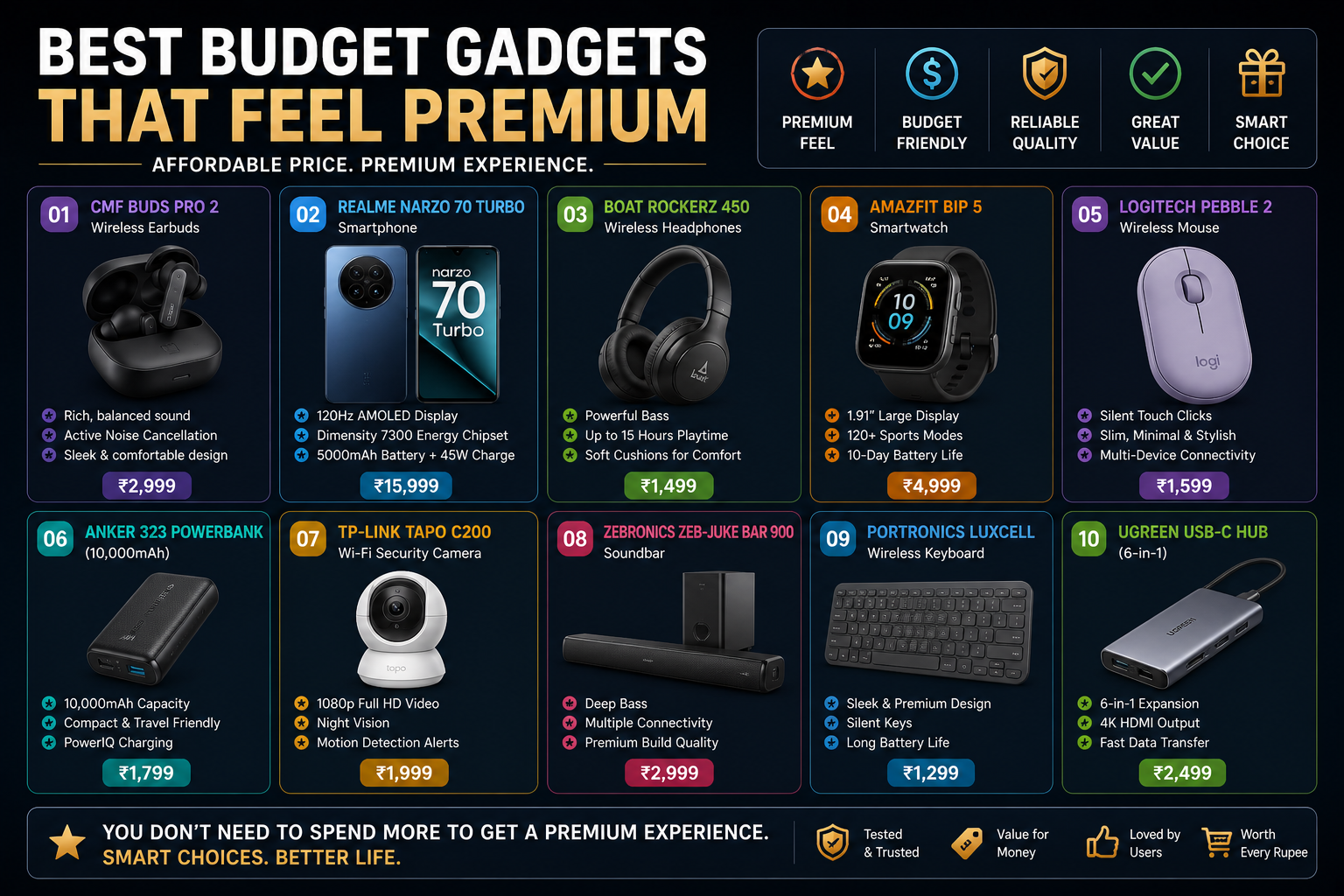
The gap between budget and premium gadgets has narrowed significantly over the last three years. Increased manufacturing competition, the commoditisation of once-expensive components like AMOLED displays and large-format batteries, and aggressive pricing from Indian brands like boAt, Noise, and Realme have produced a category of sub-₹5,000 devices that genuinely deliver experiences that felt premium just a few years ago.
But not all budget gadgets earn that description. Many cut corners in ways that are not obvious from a spec sheet — cheap microphone arrays that make calls sound terrible, battery life claims that assume near-zero usage, build quality that degrades quickly, and displays that look acceptable indoors but become unreadable in sunlight. This guide covers the budget gadgets in 2026 that actually hold up — tested against what matters in daily use, not just what looks impressive on paper.
All prices are current Indian market pricing from Flipkart and Amazon India as of May 2026.
What “Premium Feel” Actually Means at a Budget Price
“Premium feel” is a phrase that gets applied generously in gadget marketing. It is worth defining what it actually means before using it as a purchase criterion, because different people weight its components differently.
Build quality refers to the physical construction — materials, tolerances, finish, and durability over time. A plastic body is not inherently cheap-feeling; well-engineered plastic with tight panel gaps and a consistent finish can feel more premium than poorly manufactured metal. Weight distribution, button feedback, and the quality of charging ports and headphone jacks (where present) are all part of build quality.
Display quality has become the most democratised premium feature. AMOLED panels — with their deep blacks, vibrant colours, and power efficiency — are now available in smartwatches and smartphones under ₹3,000. The difference between a good AMOLED and a good IPS LCD in this price tier is immediately visible.
Performance consistency matters more than peak benchmark scores. A device that runs smoothly for 18 months without slowdown is more premium in practice than one that scores higher in benchmarks but degrades quickly. Indian budget phones in particular have had a historically uneven record here — some age well, others slow significantly within a year.
Audio quality for earbuds involves driver size, tuning, and microphone quality. Deep bass is easy to implement at any price; balanced sound with good midrange clarity and manageable highs is harder and more indicative of genuine audio engineering.
With those definitions in place, here are the budget gadgets in 2026 that deliver genuinely premium experiences for their price.
Budget Wireless Earbuds Under ₹3,000
OnePlus Nord Buds 3r — Best All-Round Budget Earbud (₹1,799)
The OnePlus Nord Buds 3r is the clearest recommendation in the sub-₹2,000 earbud segment because it gets the fundamentals right without significant compromise in any area. The 12.4mm dynamic driver is notably large for this price tier — most budget earbuds use 6–8mm drivers — and produces noticeably more low-end extension and overall volume capability than smaller competitors. Bass is present without being overwhelming; the tuning favours the kind of warm, slightly bass-forward signature that suits Indian popular music genres well.
The ANC (Active Noise Cancellation) is rated at 25dB attenuation, which is honest marketing for this price — it takes the edge off consistent background noise like fans, AC units, and road drone, but does not approach the 40–49dB performance of mid-range options. Treating it as noise reduction rather than noise cancellation sets the right expectation.
Battery life is 7 hours on the earbuds with an additional 30 hours from the case. The case charges via USB-C — an important detail at this price tier, where some competitors still use outdated Micro-USB. The connection is Bluetooth 5.3 which provides stable, low-latency pairing with most Android devices.
Call quality is the area where it exceeds expectations most clearly. The dual microphone array with environmental noise cancellation makes voice calls noticeably clearer than earbuds in this price range typically deliver — background noise from streets or offices is suppressed effectively enough that calls are comfortable in moderately noisy environments.
The fit uses three silicone ear tip sizes. The stem design and moderate weight (4.6g per earbud) makes them stable for walking and light exercise, though they are not sport-specific and lack a secure ear hook option.
Best for: Daily commuters, students, and anyone who wants a complete earbud experience — good sound, functional ANC, solid call quality — without spending over ₹2,000. It is the honest answer to “what earbuds should I buy if I have ₹1,500–₹2,500 to spend.”
Honest limitation: The companion HeyMelody app for EQ customisation is more useful than most budget companion apps but requires a OnePlus or compatible Android device for full feature access. The ANC does not compete with mid-range options at ₹4,000+.
Realme Buds T200x — Best Under ₹1,600 (₹1,599)
If ₹1,799 is over budget, the Realme Buds T200x is the correct choice below ₹1,600. The 10mm driver delivers acceptable sound quality with a warm tuning that suits casual listening. The ANC at this price is functionally marginal — it exists in the spec sheet and provides minimal real-world noise reduction — but the passive isolation from a good in-ear fit is decent.
Where the T200x genuinely punches above its price is battery life: 6 hours on the earbuds with 24 hours from the case totals 30 hours, which is competitive with earbuds costing twice as much. The case is compact and pocketable, charges via USB-C, and the overall build quality is solid for ₹1,599.
Call quality is below the Nord Buds 3r — adequate for brief calls but not comfortable for extended professional conversations in noisy environments. Sound quality is good enough for casual music listening but lacks the low-end extension of the Nord Buds’ larger driver.
Best for: First-time earbud buyers, secondary earbuds for the gym or travel where you do not want to risk an expensive device, gift purchases, or anyone with a strict sub-₹1,600 budget.
Honest limitation: If you can stretch to ₹1,799 for the Nord Buds 3r, the audio quality and call performance improvement is worth the additional ₹200. The T200x is the right choice only if the budget constraint is firm.
Budget Smartwatches Under ₹4,000
Noise ColorFit Pro 5 — Best Budget Smartwatch for Health Tracking (₹2,999)
The Noise ColorFit Pro 5 is the most complete health tracking package available under ₹3,000 in 2026. The 1.85-inch AMOLED display at 240×280 resolution is sharp, vibrant, and visible in outdoor light — a meaningful upgrade over the LCD panels that dominated this price segment until recently.
Health monitoring covers continuous heart rate tracking, SpO2 (blood oxygen saturation), sleep tracking with basic stage detection (light, deep, REM), menstrual cycle tracking, stress monitoring via heart rate variability measurement, and skin temperature sensing. The accuracy of these metrics at this price tier is appropriate for wellness monitoring — tracking trends over weeks and months — not clinical measurement. Continuous heart rate monitoring is reliable for resting heart rate and general activity tracking; athletic precision monitoring for serious training requires higher-grade sensors.
GPS is not built in, which is the meaningful functional gap versus the next price tier up. Exercise tracking for outdoor running and cycling requires carrying your phone for route and pace data. For gym workouts, walks, and general daily activity tracking, the absence of GPS is not a limitation.
The 7-day battery life is one of the most practical advantages of this device over premium smartwatches. Not having to find a charger every night is a genuine quality-of-life improvement that gets underrated in spec comparisons. Bluetooth calling is available — you can answer calls through the watch speaker — with acceptable clarity for brief conversations.
The companion Noise Health app is functional and well-designed for an Indian brand at this price point, providing health data history, sleep summaries, and workout logging.
Best for: Anyone who wants comprehensive health monitoring in a good-looking device without daily charging anxiety, particularly fitness beginners building healthy tracking habits or users upgrading from a basic fitness band.
Honest limitation: GPS-dependent runners or cyclists who want accurate outdoor pace data need to look at the next tier up (₹5,000–₹8,000 range for GPS-equipped options like the Amazfit GTS 4 Mini). The health metrics are wellness indicators, not medical-grade measurements.
boAt Wave Enigma — Best Budget Smartwatch for Display Quality (₹1,799)
At ₹1,799, the boAt Wave Enigma delivers an AMOLED display experience that genuinely surprises. The 1.69-inch display at 240×285 resolution with 500 nits peak brightness is clearly readable in most outdoor lighting conditions — something LCD-equipped watches at this price struggle with significantly. The always-on display option is available, though enabling it reduces battery life from approximately 7 days to 4 days.
Health monitoring is less comprehensive than the Noise ColorFit Pro 5 — heart rate, SpO2, step counting, and sleep tracking without the detailed stage breakdown or HRV stress monitoring. For users who primarily want notifications and basic activity tracking rather than a comprehensive health platform, this is adequate.
Build quality uses a zinc alloy case that has a noticeably more solid feel than the plastic construction of most smartwatches at this price. The silicone band is comfortable for all-day wear and available in multiple colour options.
Bluetooth calling quality is average — usable for brief calls in quiet environments, not comfortable for long conversations or noisy environments.
Best for: Users who prioritise display quality and build feel at the lowest possible price point, and who want a device that looks and feels more expensive than it costs without needing the full health monitoring suite.
Honest limitation: The health monitoring feature set is genuinely limited at this price. If comprehensive health tracking matters to you, the ₹2,999 Noise ColorFit Pro 5 is worth the step up.
Budget Smartphones Under ₹15,000
Redmi 13 5G — Best Budget Smartphone Overall (₹10,999)
The Redmi 13 5G represents the current best answer to the question of how much smartphone you can get for ₹10,999. The MediaTek Dimensity 6100+ processor delivers consistent performance for daily tasks — social media, messaging, web browsing, video streaming, navigation — without the stuttering or thermal throttling that afflicts some competing devices in this tier. Gaming at medium-to-high settings in popular titles (BGMI, Free Fire, Call of Duty Mobile) runs acceptably, though demanding titles at maximum settings cause frame rate instability.
The 6.79-inch display at 1080×2460 resolution (FHD+) with 90Hz refresh rate is one of the strongest hardware specifications in this price range. The 90Hz refresh rate makes scrolling and navigation noticeably smoother than the 60Hz panels on cheaper alternatives, and FHD+ resolution keeps text and images sharp. The LCD panel has a brightness ceiling around 450 nits, which is adequate for most indoor and partially shaded outdoor use but can be hard to read in direct sunlight.
Camera performance is a 108MP main sensor which captures acceptable detail in good lighting — usable for social media and casual photography — but struggles in low light in ways that become obvious when compared to mid-range competition. This is a hardware physics limitation at this price tier: smaller sensor sizes and less sophisticated image processing produce noisier night shots regardless of the megapixel count. The 108MP figure is a marketing number that does not translate proportionally to photography quality.
The 5000mAh battery consistently delivers 1.5–2 full days of mixed usage on a charge, and 18W fast charging (charger included in the box, which is no longer universal even at higher price points) takes the battery from 20% to full in approximately 75 minutes.
MIUI 14 on Android 13 is heavily customised and includes pre-installed applications that cannot be uninstalled — a common complaint with Xiaomi’s software approach. The software experience improves meaningfully if you spend 30 minutes disabling or hiding unwanted apps and notifications during initial setup.
Best for: Buyers who want a dependable daily smartphone with good display quality, reliable 5G connectivity, and strong battery life without spending over ₹12,000. The Redmi 13 5G covers the needs of the majority of Indian smartphone users.
Honest limitation: Camera low-light performance is mediocre, which matters if photography is important to you. The software comes with bloatware that requires active management. Buyers prioritising camera quality at a budget should look at the Realme 12x 5G or Motorola G series alternatives at similar prices.
iQOO Z9x 5G — Best Budget Performance Smartphone (₹12,999)
The iQOO Z9x 5G is the recommendation for users who specifically prioritise processing performance and gaming above all else in the sub-₹15,000 range. The Qualcomm Snapdragon 6s Gen 3 chipset outperforms every competing processor in this price bracket in sustained workloads — it handles demanding games, intensive multi-tasking, and prolonged camera recording without the thermal throttling that causes competitor devices to slow down under extended load.
The 6.72-inch IPS LCD at 1080×2408 resolution with 120Hz refresh rate is the smoothest display in this price category. 120Hz at under ₹13,000 is unusual and makes a perceptible difference to the feel of the device in daily use. Display brightness at 1000 nits (peak) is genuinely good for this price tier, making it readable in direct sunlight where many competitors struggle.
The 6000mAh battery is one of the largest in this price segment and delivers genuine 2-day battery life for moderate users. 44W fast charging takes the battery from empty to full in approximately 65 minutes.
The camera is the iQOO Z9x’s relative weakness — a 50MP main sensor that performs well in daylight and acceptably in mixed lighting but does not approach the computational photography quality of Pixel A-series or mid-range Samsung devices. For performance-first users who want a device that handles everything they throw at it without camera excellence being a priority, this is a strong choice.
Best for: Gamers, heavy multi-taskers, and anyone who wants maximum processing and display performance at under ₹15,000 and can accept a camera that is good but not exceptional.
Honest limitation: iQOO’s Funtouch OS is cleaner than MIUI but still includes some pre-installed apps. The camera, while adequate, is clearly behind devices at ₹20,000+ in low-light performance.
Budget Laptop: Where the Compromises Actually Live
Lenovo IdeaPad Slim 3i (Intel Core i3 13th Gen) — Best Budget Laptop Under ₹40,000 (₹34,990)
Budget laptops under ₹40,000 involve real compromises, and the honest buyer’s guide approach is to be explicit about what those compromises are rather than glossing over them. The Lenovo IdeaPad Slim 3i at ₹34,990 is the most defensible choice in this price range because it makes its compromises in the right places.
The 13th Gen Intel Core i3-1305U processor handles the full scope of student and office productivity tasks — Microsoft Word, Excel, PowerPoint, web browsing with multiple tabs, Google Classroom, coding in Python or JavaScript, and video calling — without issue. Where it noticeably struggles is video editing (DaVinci Resolve, Premiere Pro will run but render slowly), running multiple heavy applications simultaneously, and any GPU-intensive task. These are the honest limitations of an entry-level processor.
The 8GB DDR5 RAM is the minimum viable configuration for Windows 11 in 2026 — it handles typical productivity workloads but will show memory pressure with heavy multi-tasking (10+ browser tabs, Office suite, video call simultaneously). The 512GB SSD storage is fast and more than adequate for documents, applications, and a modest media library.
The 15.6-inch FHD (1920×1080) TN display is the most visible compromise in the package. TN panels have narrower viewing angles than IPS — colour accuracy shifts noticeably when viewed from the side or above — and lower colour gamut coverage, which matters if you do any photography or design work. For straight-ahead document and web work, it is adequate. For content creation or media consumption where colour and viewing angle matter, this is a meaningful limitation.
Battery life is approximately 6–8 hours of mixed productivity work — enough for a full college day or typical office day, but not the all-day endurance of the MacBook Air or premium ultrabooks. The charger is a standard 65W barrel connector (not USB-C charging, which is an inconvenience for users who want to charge from a power bank or universal charger).
Build quality is polished plastic — it does not feel cheap but it does not feel premium. The keyboard has 1.5mm key travel and is comfortable for extended typing. The touchpad is adequately sized and responsive for Windows navigation.
Best for: Students who need a reliable laptop for college coursework and basic productivity, first laptop buyers, or professionals whose computing needs are primarily email, documents, and web-based work, and for whom the ₹35,000 price point is the genuine limit.
Honest limitation: The TN display is the purchase you will notice every day. If display quality matters to you at all — for media consumption, photography, or long daily usage — saving up to ₹55,000 for the IPS-display IdeaPad Slim 3 AI is worth it. Do not compromise on display quality if you can avoid it.
The Real Framework for Buying Budget Gadgets That Do Not Disappoint
The single most effective approach to buying budget gadgets is identifying which specification matters most for your specific use, and finding the device that optimises for that specification rather than averaging across all of them.
Budget earbuds optimise for one of: sound quality, ANC effectiveness, battery life, microphone quality, or design. They rarely excel at all simultaneously. If you spend most of your time on calls, prioritise microphone quality. If you use earbuds for music in noisy environments, ANC matters most. If you forget to charge things, battery life is your priority.
Budget smartwatches trade off between display quality (AMOLED vs LCD), health monitoring completeness, GPS, and battery life. No device under ₹4,000 has all four.
Budget smartphones trade off between processing performance, camera quality, display quality, and battery life. The iQOO Z9x optimises processing; the Redmi 13 5G balances all four reasonably. Knowing which matters most to you produces a better purchase decision than reading a generalised best-of list.
The second most effective approach is to research after-sales service availability for the brand you are considering, specifically in your city. A ₹3,000 smartwatch from a brand with no authorised service centre in your area is a riskier purchase than the same device from boAt, Noise, Samsung, or Realme — all of which have broad national service networks in India.
This article is written for informational purposes to help readers make informed purchasing decisions. Prices, product availability, and specifications change frequently. Always verify current pricing on Flipkart, Amazon India, or official brand websites before purchasing. TechRealOnline does not guarantee pricing accuracy at the time of reading.